
When researchers placed a chicken carcass in a forest in Ecuador, their aim was to learn more about the local scavenger community. What they didn’t expect to record was the first case of a greater grison – a small, slender, carnivorous mammal – launching an attack on a group of turkey vultures.
Upon detecting the attacker, the turkey vultures immediately took flight, along with a nearby black vulture.
Writing in the Journal of Raptor Research, the scientists interpret the carnivore’s direct lunging posture as evidence of an opportunistic predation attempt. If that interpretation is correct, the encounter would be the first documented case of a greater grison trying to prey on a turkey vulture.
Most documented cases of vulture predation occur at nests, affecting eggs and nestlings; records involving adults are much rarer. “Few records involve adult vultures, likely because of their strong flight abilities and use of communal roosts,” say the authors in the study.
That said, adult turkey vultures are not invulnerable, with a number of documented predation events in the Americas involving large raptors such as bald eagles and golden eagles, mammals such as raccoons and jaguars, and reptiles such as boa constrictors.
The latest case was observed during a study on scavengers in Jama-Coaque Reserve, a private reserve in Ecuador’s Tumbes–Chocó–Magdalena biodiversity hotspot. As part of the study, the researchers placed a chicken carcass on the ground next to a tree and set up a camera trap in front of it.
The camera-trap images show three adult turkey vultures perched on the roots of the tree before a grison emerges from the undergrowth and lunges at them. The turkey vultures immediately take flight, along with a nearby black vulture. The grison then remains on the roots for around one minute, sniffing around the vultures’ perch, before disappearing out of shot.
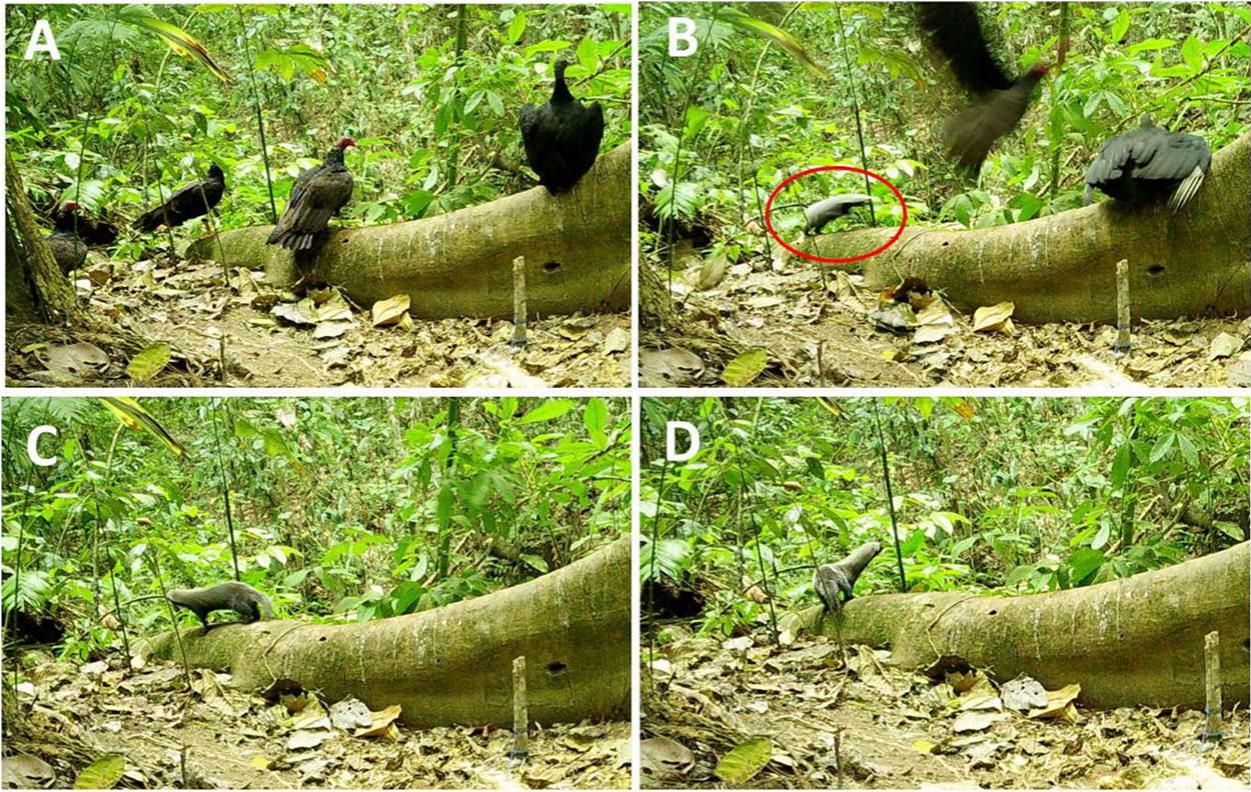
The team believe this is the first known case of a direct attack attempt by a greater grison on a vulture. So, why did it do it?
“We ruled out the possibility of kleptoparasitism [where one animal steals food or prey from another] because the experimental carcass had been completely consumed before the recording began,” say the researchers. “Additionally, the grison showed no interest in the remains (bones and feathers) present at the site.”
Could the attack have been territorial? Greater grisons have previously been documented acting aggressively towards raptors during food consumption. Other mustelids (a family of carnivorous mammals to which the greater grison belongs) in Africa, such as the African striped weasel and the honey badger, are also known to confront larger species while displaying strong territoriality. However, in this instance, the researchers could neither prove nor disprove whether the attack was territorial because they were unable to gather additional photographic records of the grison in the area.
Instead, the team believe that “the direct lunging posture displayed by the grison was more consistent with an opportunistic predation attempt.”
The researchers suggest that living in groups helped the vultures detect the threat and escape together, likely preventing the grison from pinning down a target. “Although group formation in vultures may increase competition for food, it also provides antipredator benefits by enhancing collective vigilance and reducing attack success… In our recorded case, group size likely improved vigilance and triggered the simultaneous flight of all individuals, making this strategy effective against potential predators.”
This rare encounter offers a glimpse of vulture foraging and vigilance strategies, as well as the behaviour of carnivores such as the greater grison. It also highlights how camera traps can reveal interactions that might otherwise go unseen – observations that contribute to understanding how food webs work in highly threatened ecosystems.
Read more about the study, published in the Journal of Raptor Research.
More wildlife stories from around the world
- Scientists find 650-year-old sandal in vulture nest deep in Spanish mountains. And that's not all
- Birdwatchers spotted a black vulture nesting on the roadside. What it was sitting on amazed them all
- Oregon’s biggest city was drowning in crow poop. Then a new predator came to town
- Researchers hid cameras in an abandoned house in Argentina – and found carnivores sharing a room inside it
Top image: great grison attacks vultures. Credit: Image adapted from Paul Monar-Barragán et al., Journal of Raptor Research 2026, under the CC BY-NC-ND 4.0 license.


