
Sure, dogs bark, growl and howl. But did you know they can scream, chatter and whistle, too?
The dhole or ‘whistling dog’ is a formidable and co-operative hunter that relies on these strange vocalisations to communicate with pack members across dense vegetation and bring down prey far larger than itself.
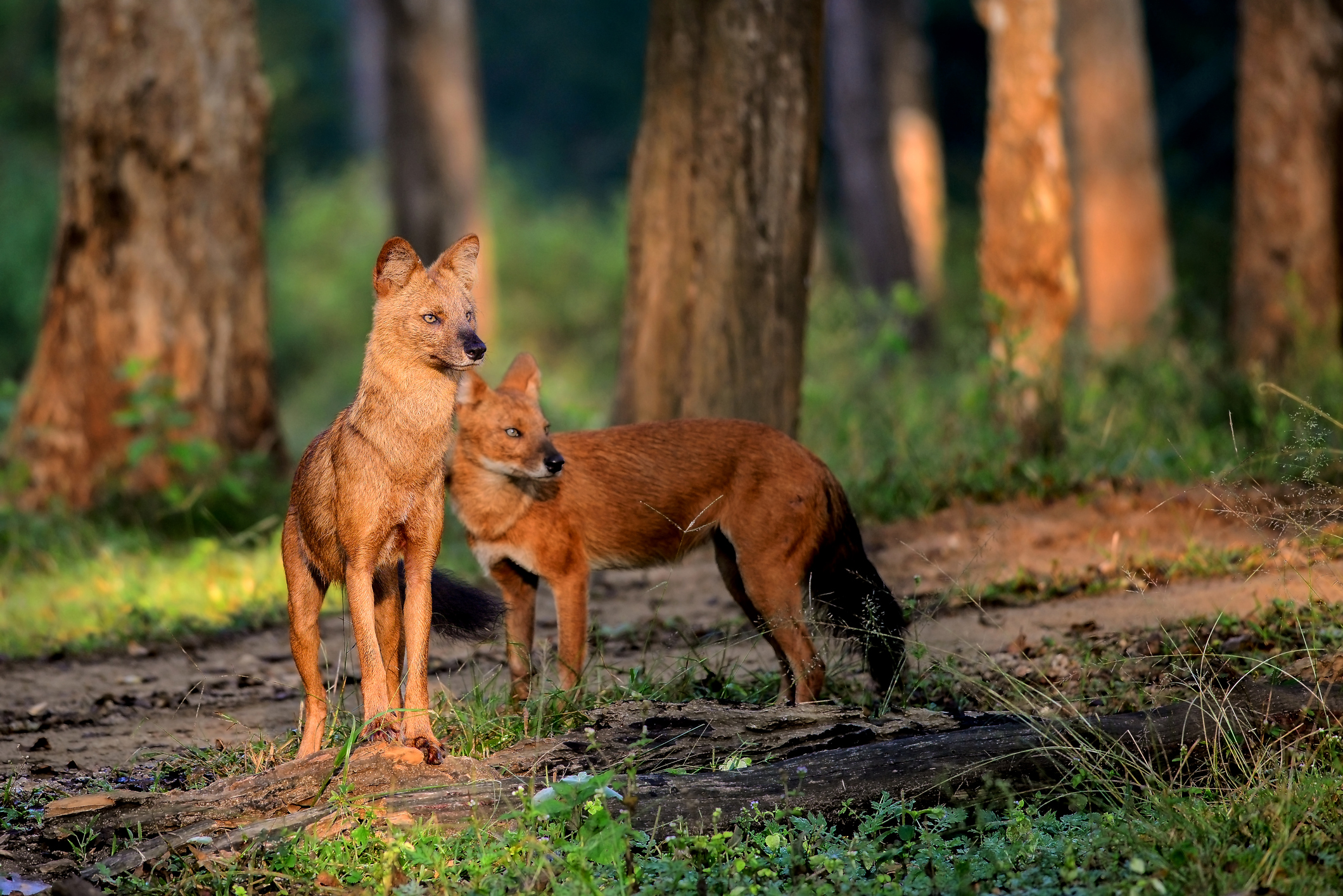
With a russet coat and pale underparts, this canid could almost be mistaken for a red fox but is significantly larger and far less common across its fragmented Asiatic range.
Where does the dhole live?
The dhole is found across parts of South and South East Asia, with surviving populations in countries including India, Bhutan, Nepal, Myanmar, Thailand, Cambodia, Laos, Malaysia, Indonesia and southern China.
It was once found as far north as Russia and as far west as Kazakhstan and Pakistan, but the IUCN states that the species has disappeared from more than 75 per cent of its historic range and most remaining populations are fragmented.
The dhole is adaptable in the habitats it uses. It can live in forest, scrub, grassland and alpine areas, provided there is enough cover and sufficient prey.
How big is the dhole?
About the size of a border collie, the dhole measures about 130cm long and 50cm tall and weighs between 12 and 20kg.
What does the dhole look like?
It usually has a rich reddish-brown coat, paler underparts, rounded ears and a thick, fox-like tail, often with a dark or black tip. Compared with some other canids, the dhole has a relatively short jaw and fewer lower molars. Its athletic build is most obvious in motion: it excels at running, swimming and jumping.
- 10 rarest dogs in the world, many on the brink of extinction, from the beautiful Ethiopian wolf to the bizarre aquatic bush dog...
- "It has a reputation for cunning, opportunism and haunting twilight calls..." Does this wild dog really deserve its bad reputation?
Is the dhole social?
Yes. The dhole lives in packs, commonly of about 5–12 individuals, although packs sometimes join together to form large gatherings that can number more than 30 individuals. Each pack is led by an alpha male and alpha female. Pack life allows it to hunt and raise young cooperatively. Individuals greet each other with tail-wagging, and aggression between neighbouring packs is rare.
Why is the dhole called the whistling dog?
This canid’s unusual ability to whistle has earnt it the nickname ‘whistling dog’, as well as ‘whistling hunter’. (Other names include the Asiatic wild dog, red dog and Indian wild dog). Unlike many of its higher-pitched calls, the whistle is relatively low-frequency, which means it can travel farther through the cluttered soundscape of a forest.
This helps when a pack (or multiple packs) are working together to take down prey, as dispersed individuals are able to effectively communicate by whistling without losing the element of surprise. According to the Dhole Conservation Fund, alongside its whistles, the dhole also whines, mews, yaps, squeaks, screams, growls and chatters.
- It may look like a dog, but don’t be fooled – Africa’s most efficient killer, which can travel up to a staggering 72km/h, is neither a wolf nor a dog
- It might be called a fox and look like a fox, but don't be fooled as this is no fox...
What does the dhole eat?
The dhole is predominately a carnivore, with meat making up at least 70 per cent of its diet. Rather than cache food, it tends to quickly eat prey on the spot before scavengers can interfere. It is a remarkably rapid eater and an adult can consume up to 1kg in four minutes.
It particularly feeds on ungulates (hoofed mammals), including deer, wild pigs, wild goats, gaur and banteng, though this varies depending on what is available in a particular location. It may also take smaller animals such as rabbits, lizards and insects, and has been recorded eating fruit or berries on occasion.
How does the dhole breed?
The breeding season varies across the dhole’s range. After a gestation of about 60–62 days, the female gives birth in a den. A litter of three or four pups is common, though larger litters are possible. Interestingly, the female dhole has up to 16 teats, which is more than other canid species possess. Pack members help feed the nursing mother and later the pups, often by regurgitating meat after a hunt. Young animals remain near the den at first, then gradually begin travelling with the pack. They are fully grown at about one year old and reach sexual maturity at around three years.
- I spent 7 years tracking an elusive wolf pack through the snowy wilds of Canada. My encounters were mind-blowing
- “I see it before the wolves do.” A huge predator encroaches on a wolf pack. They have no choice but to confront it
Does the dhole face any threats?
The dhole is listed as Endangered and the IUCN cautiously estimates that there is a total population of between 4,500 and 10,500 individuals, but the species is subject to marked local population fluctuations. The main threats are habitat loss and fragmentation, the decline of wild prey, persecution linked to livestock predation, and diseases such as canine distemper and rabies that can pass from domestic dogs.
One difficulty in protecting the dhole is that it remains poorly studied across much of its range. Researchers are still working to understand where it survives, how populations are connected and which threats matter most in different landscapes. What is clear is that the dhole needs large, connected habitats with healthy prey populations and lower levels of conflict with people.


