
Many mammal societies are ruled by matriarchs. These females make critical decisions for the group and use their hard-won wisdom to lead in times of trouble. In these societies, life tends to be structured around female friendships and family ties, with males playing a secondary role.
In some insect societies, males have only one role: to mate. Females do everything else, from building their home, defending it from predators and keeping it clean, to gathering food and raising offspring.
- Deadliest females: 11 ferocious female animals that you wouldn't want to mess with
- Which animal has the longest pregnancy? How one female species makes the ultimate sacrifice
Taking things to an extreme, some reptilian females have done away with the need for males altogether, having figured out how to reproduce all by themselves.
In this list of the top ten females that rule, we’ll explore female-led species across the animal kingdom, from killer queens, to grandmother whales, to murderous matriarchs, and a lizard who doesn’t need males at all.
10 females that rule
Western honeybees (Apis mellifera)

Western honeybee hives contain three types of bee: the queen, who is able to reproduce, sterile workers, all of whom are female, and male ‘drones’.
While the queen lays eggs (as many as 2000 per day), the workers see to the other tasks in the hive, like foraging for food, feeding larvae, and even carrying out ‘undertaker’ duty (collecting dead bodies and depositing them outside).
- Honeybee guide: how they produce honey, why they sting, and a history of beekeeping
- It’s bigger than your thumb, has immense jaws and is nicknamed the flying bulldog – Meet the largest bee on Earth
Drones, on the other hand, have only one job: to mate with a queen. They do this in summer, and once they have mated, they die. If they don’t die before the end of summer, the worker bees kick them out of the hive. This is called ‘drone eviction’ and is done to save resources, because drones can’t forage for themselves and so quickly use up the resources that the females work hard to gather.
While it might sound like workers and drones have drawn the short straw, queens don’t have it easy either – especially at the start of their adult lives.
Workers decide which larva will become a queen by feeding it ‘royal jelly’. But workers often feed a few different larvae with royal jelly, and newly emerged queens must try to seek out and kill one another (often sounding a ‘battle cry’ before doing so).
The one remaining queen is the one who gets to rule the roost.
Naked Mole Rats (Heterocephalus glaber)

Naked mole rats (also known as sand puppies) are a rodent native to East Africa. They live underground in colonies of around 80 individuals, and their society is surprisingly similar to that of honeybees.
- Naked mole rat: what they are and how the queen rules the colony
- The naked mole rat's superpower: Here's what it reveals about living longer
Only one female in a colony – the queen – reproduces. When she eventually dies (or is dethroned), other females compete to take her place. They often fight to the death.
There are usually one to three reproducing males in each colony, and the rest of the colony are non-reproducing workers. These can be either female or male.
Like in honeybee society, workers carry out lots of different tasks, from caring for offspring, to finding food, to maintaining underground tunnels, to protecting the colony from predators.
However, unlike in honeybee society, workers don’t tend to be very excited about their jobs. The queen has to play an active role in keeping her workers on-task, and she does this by repeatedly shoving them!
Spotted Hyenas (Crocuta crocuta)

Native to sub-Saharan Africa, the spotted hyena has a social system unlike any of its relatives – it is much larger and much more complicated.
Female spotted hyenas are bigger than males, and are socially dominant to them. This means that females get first dibs on resources like freshly killed prey. Even the lowest-ranking female usually outranks the highest-ranking male.
Each hyena clan is led by a matriarch, the highest-ranking female. She has the final say about group matters, like when the clan will hunt, eat and sleep.
Who gets to be matriarch is dependent on family rank. Each female hyena inherits the rank just below her mother, with younger sisters out-ranking older ones. This means that when the matriarch dies, her youngest daughter will become the new top dog.
Bizarrely, spotted hyena females have evolved pseudo-penises with which they mate. As a result, and unlike in many other species, females always get to choose when and with whom they mate.
- Meet the female carnivore with no vagina but a clitoris the size of a milk bottle
- The world's weirdest penises – including a detachable one that swims off after a mate and another that grows back three times
African Bush Elephants (Loxodonta africana)

Also native to sub-Saharan Africa, African Bush Elephants live in close-knit family units – usually several adult females, their daughters, and their pre-teen sons. Once the sons reach puberty, they leave this unit to live alone or to join roaming groups of bachelor males. Meanwhile, females stay in the family units they were born into.
- Elephant guide: where do they live, what do they eat and how to identify them
- Elephant graveyards: is there any truth in the legend elephants go to a special place to die?
Each family unit has a female leader. Unlike in hyenas, this female is not born into her rank, and unlike in naked mole rats and honeybees she does not fight her way to the top. Instead, she is chosen by her family based on age, experience, and knowledge.
Scientists have found clear evidence that older females are the best leaders. When faced with lions, family units with young matriarchs tended to underreact to the threat, while family units with older matriarchs responded appropriately. This suggests that, due to life experience, older matriarchs are better judges of how to respond in dangerous situations.
Anglerfish

Deepsea Anglerfish have a rather unusual way of reproducing.
Males, who are a fraction of the size of females, use their phenomenal sense of smell to sniff out females. Once a male has found a female, he latches onto her body with his mouth.
This means he can no longer feed. Unable to get his own nutrients, his blood system fuses with the female’s so that she can provide him with everything he needs. He even loses his eyes, as he no longer has any need to see.
Basically, when a male attaches to a female, he becomes nothing more than an extra organ that supplies her with sperm.
The female, meanwhile, goes about her daily life pretty much as normal – except now she has a constant supply of sperm, meaning she can produce offspring for the rest of her life.
Ring-tailed Lemurs (Lemur catta)
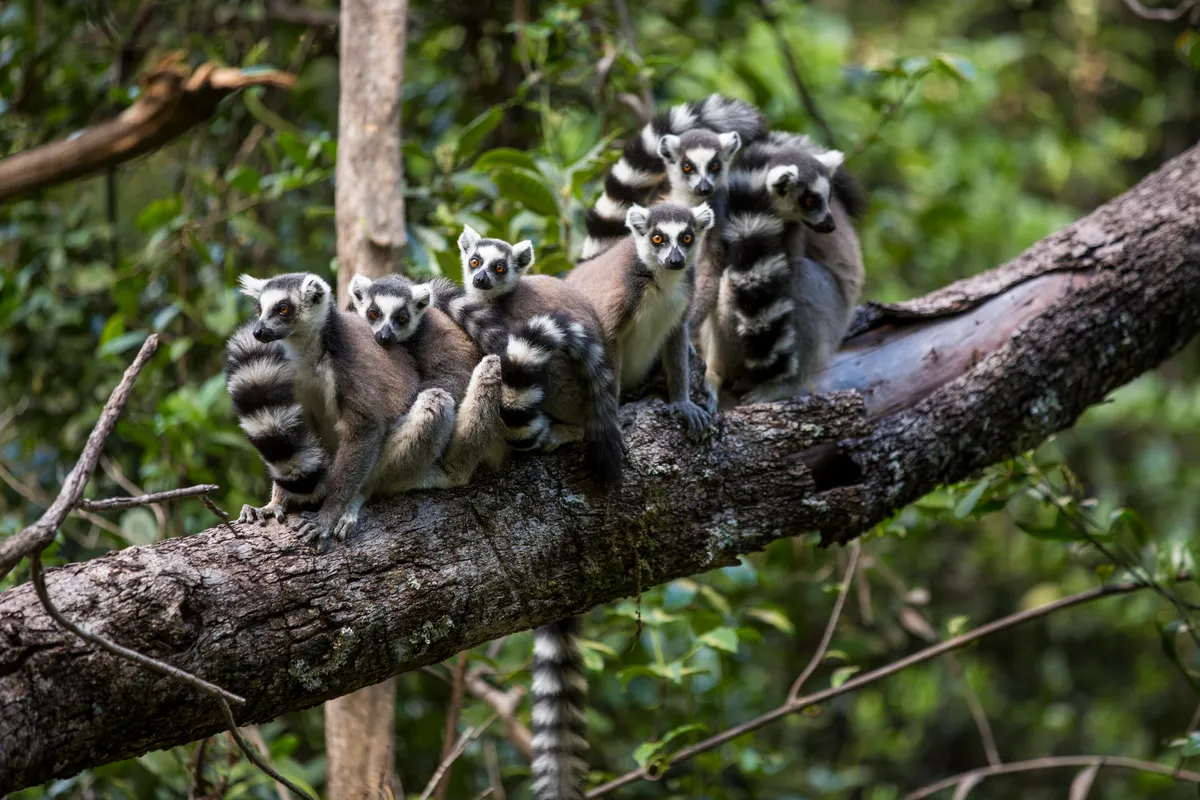
Endemic to Madagascar, ring-tailed lemurs are one of the most recognisable primates. But while many people know what they look like, what is not so well-known is that their societies are ruled by females.
Each group of ring-tailed lemurs, known as a troop, can be up to 30 individuals strong and is comprised of both males and females. But females rule over males, and get first choice of food, sleeping spots, and who to mate with.
Troops hold territories, and there are sometimes disputes over borders. When this happens, it is the females who lead the troop into battle – babies in tow!
Meerkats (Suricata suricatta)

Meerkats, native to Southern Africa, have some of the most murderous matriarchs on the planet.
Meerkats live in family groups of up to 50, ruled by a matriarch and her male mate. This matriarch wants to be the only female in the group to reproduce, and she will do all manner of ghastly things to make sure this is the case.
For example, if one of her sisters or daughters dares to have babies, she is likely to kill the pups and banish the mother (which is itself, often, a death sentence).
Non-alpha females are therefore kept in check by their rather tyrannical leader. Instead of having their own pups, they cooperate on tasks such as foraging, looking out for predators, and caring for the matriarch’s babies.
Bonobos (Pan paniscus)

Native to Central Africa, bonobos are famously known as the chimpanzees’ peaceful cousin.
In chimpanzee society, males tend to be dominant over females, while in bonobos females tend to be higher-ranking than males. However, in one-on-one interactions, male bonobos do outrank females. It is at the group level that females rule.
- Bonobo guide: where they live, how they’re related to chimps, and why they have such a fascinating society
- Your 60 second guide to bonobo behaviour
An old, experienced matriarch sits at the top of bonobo society, and she earns this title through her age, experience, and her ability to form close friendships with other females in the group.
If a male bonobo threatens a female or infant, chaos may ensue. Females are likely to form a mob and violently attack him, sometimes leading to his disfigurement or even death.
Female bonobos may seem peaceful, but they are not to be messed with!
Resident Orcas (Orcinus orca)

Resident Orcas, native to the Pacific Northwest, live in female-centric societies. The smallest unit of their society, the matriline, is usually led by one elder female (the matriarch, who might live to be 100 years old). Other matriline members include the elder female’s sons and daughters, and her daughters’ offspring.
- “No other predator is able to challenge them” – this deadly, intelligent ocean killer works in a team to stun, submerge and launch at its prey
- "Raw and brutal": whale watchers look on astonished as orcas kill humpback whale in South Africa
Like humans, orca females go through the menopause. This means that matriarch orcas can no longer reproduce. They are, however, vital to their group, because they have the cultural and ecological knowledge needed for survival.
Adult males get a particularly big boost from having their mother, the matriarch, around. They live longer, healthier lives when their mother is present because she will share food with them (even chopping up their fish!), and protect them during fights.
- Orcas are now hunting whale sharks – and they're doing it in an astonishing way
- Ocean's most powerful, ruthless killers: The world's top 9 marine predators that rule the waves
Studies have shown that these elder females are also crucial for their grandchildren – calves with a living maternal grandmother live for longer than those without one.
New Mexico whiptail lizard (Aspidoscelis neomexicana)

The New Mexico Whiptail Lizard, native to the southwestern United States and northern Mexico, has done away with males altogether. Females are able to reproduce via ‘parthenogenesis’, which basically means they can clone themselves.
Strangely, the females still engage in the ‘act’ of mating, but – as there are no males in the species – only with other females. It is thought that this stimulates ovulation.
While creating clones of themselves is a good strategy in the short-term, relying on parthenogenesis could cost these ladies in the longer term, because they might not have the genetic variation they need in order to adapt to a changing environment.
Still, for now, the parthenogenic strategy is working pretty well for them, and as an all-female species, the New Mexico whiptail lizard definitely deserves top spot on this list.
- Why promiscuity pays off for female dunnocks
- Why are most female raptors larger than males?
- "In real life Nemo’s dad would become female (and might have even mated with his son) – Discover 10 animals that can amazingly change sex
- This deadly female octopus plans to eat her partner after sex. But the male has a defensive trick in his tentacles


