Is it possible that a river could flow in two directions? That's the incredible claim made of the Echimamish River in Manitoba province, Canada. And this is not just the sleep-deprived findings of a 17th-century explorer lost in a trackless wilderness.
In 2025, a review of the America's most unusual river flows, published in Advancing Earth and Space Sciences journal, said: “In our review, the Echimamish River was the most obscure, the most baffling, the most unique to investigate...”
- Could this endearing mammal be the reason Canada exists?
- This lake in Canada just vanished. And it's not coming back
A typical river flows from a spring, usually in an upland area such as a hill. The water flows gradually downhill gathering more volume from tributaries before eventually entering the sea at the river's estuary. The Echimamish appears to do none of these things. Located about 70km north-east of Lake Winnipeg, it runs for about 67km between the much longer Hayes and Nelson rivers, which themselves drain into Hudson Bay to the north.
For most of its length, the Echimamish flows through boggy, peaty wetland and this accounts for its dark colouration and old, alternative name of Blackwater Creek.
From the 17th century, European fur traders used the river as a more reliable route to Hudson Bay than more unnavigable upper reaches of the Hayes and Nelson rivers. They learned the name 'Echimamish' from the local native Cree people meaning “water flowing both ways” or “river that flows downstream in both directions” and began to notice that the name held a strange truth. Sluggish though it was, the water west of an ill-defined middle point of the river seemed to flow west to the Nelson River. And perversely, the water east of the 'middle' flowed the opposite direction 'downstream' towards the Hayes River.
- The Colorado River vanished for 5 million years. Scientists may have just figured out where it went
- "It's famous for the mighty river that snakes through its forests, but high above the canopy, another vast river is moving…" – Discover the Amazon's 'Flying River'
- It stretched a humongous 250km and blocked a mighty American river for 900 years. Then humans destroyed it, unleashing a disaster
In 1819, British explorer and naval officer John Franklin placed the middle point of the river at the Painted Stone “a low rock 10 or 12 yards across, remarkable for the marshy streams that arise each side of it, taking different courses”. The Painted Rock was a site sacred to native people and a portage point for boats to be carried over land a short distance between navigable stretches of water.
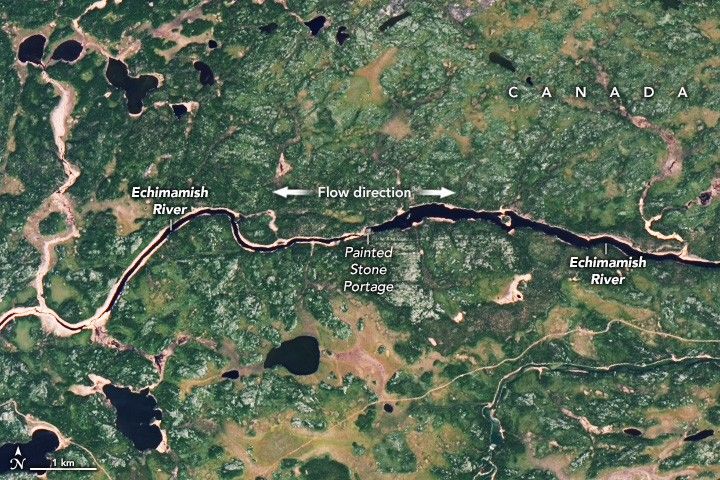
Later visitors to this remote spot found that the middle point was incredibly hard to pinpoint in the flat, swampy landscape. Expeditions in the 20th century by wilderness canoeist Eric Morse (1957) and researcher Sheldon McLeod (1975) concluded that a beaver pond some in the middle of the river is the true source or 'headwater'. McLeod went a step further saying “the point at which the flow splits appears to be capable of moving.”
- This river contains around 500 deadly saltwater crocodiles. It’s just been approved for the rowing and canoeing events at the Brisbane Olympics
- It's home to sharks, crocodiles and a deadly 'lethal cocktail' of bacteria, diseases and body parts
Examining these accounts, Robert Sowerby, one of the authors of the 2025 journal paper concludes: “it [the Echimamish River] is so flat that its headwaters - the point where the flow splits - can actually move by several kilometers. The conditions have resulted in conflicting historical records, if not mythical musings, some of which are still not resolved. In any case, the Echimamish remains a curious river that eludes strict definition.”
Experts have even surmised that a newly constructed beaver dam could have such an impact in this swampy landscape that it alter the point where the river's flow splits. Sowerby also a theorises that the Echimamish River is in a state of flux and its formation is still in progress. It might, he says, eventually capture the upper Hayes River or will separate completely into the Hayes and Nelson basins.
For now, deep in the wilds of Canada, there remains a river that truly flows in both directions!
top image: Pinawa, Manitoba, Canada. View of the river in the Pinawa Dam Provincial Heritage Park. The river pictured is not the Echimamish River. Credit: Eduardo Fonseca Arraes/ Getty Images
Discover more wildlife stories from around the world: