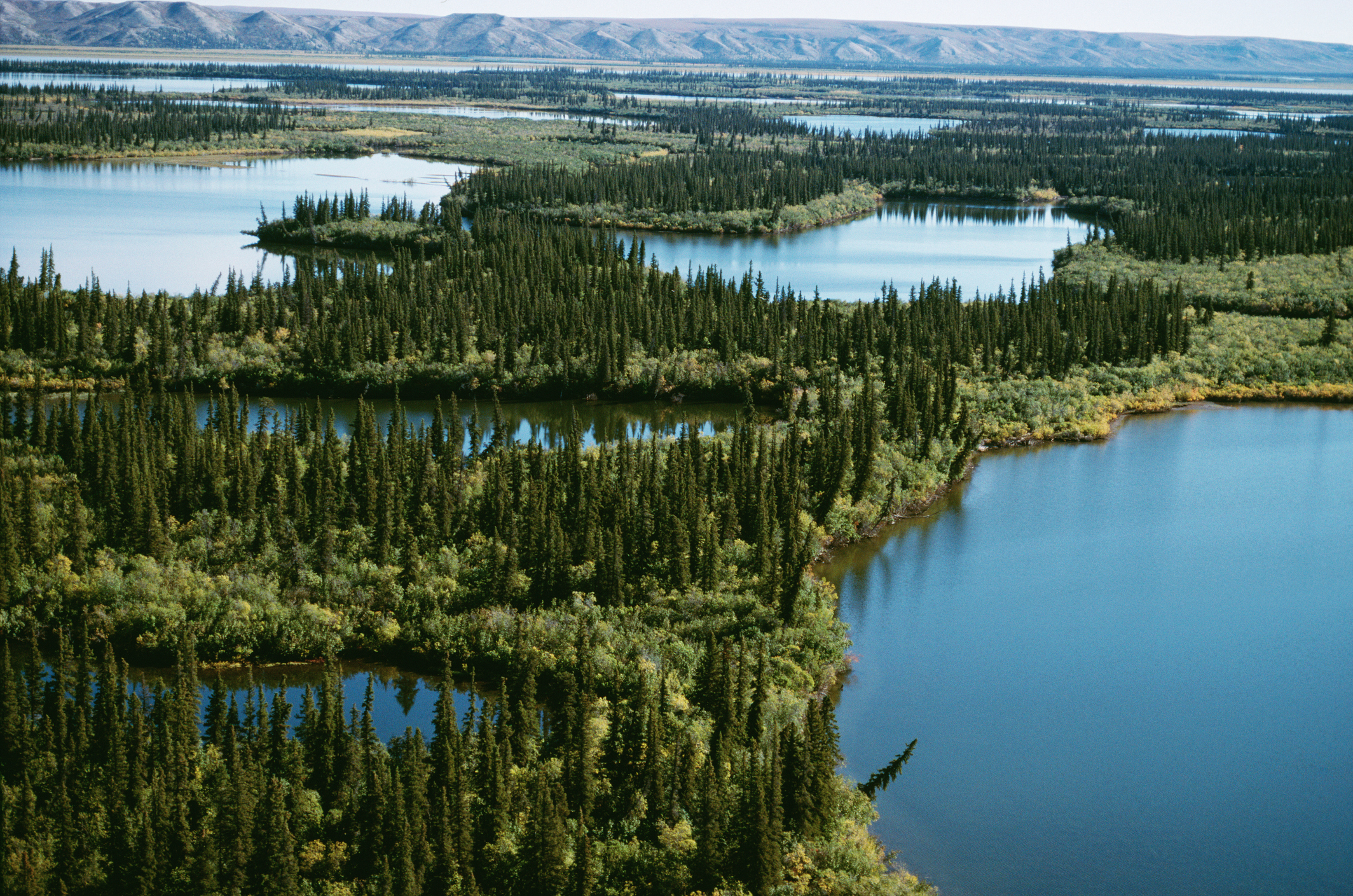
When we think of rivers, we imagine water flowing freely from source to sea. But for some of the world's great waterways, their natural state is to be blocked or dammed by fallen trees – on a massive scale. Today, the world's largest tree-blockages or logjams can be found in the delta of Canada's mighty Mackenzie River.
.While the word 'logjam' is a byword for life's annoying obstacles, recent studies have shown that river logjams are vital for wildlife and human communities, and are crucial stores of carbon.
The Mackenzie River, named after Scottish explorer Alexander Mackenzie (1764-1820), is the largest river that flows entirely within the boundaries of Canada. From its source in the Great Slave Lake of Canada's Northwest Territories, it flows almost 1800km north through sparsely inhabited, forested lands to the Beaufort Sea and the Arctic.
- It can be seen from space, is the equivalent to 8 football fields and could be 45 years old - but we have no idea how many families live there…
- East River DNA reveals secrets of life (and death) in New York
- 8,400 years ago, a lake bigger than France suddenly disappeared. What happened next changed Earth forever
The total river system, including the main river and key tributaries such as Liard River, Peel River and Great Bear River, comprises 4200km of waterways and drains 1.8 million sq km – 20 per cent of Canada's land area. At 13,000 sq km, the delta is the second largest Arctic river delta after Russia's Lena River. And it is the delta where most of the logjams are located – 52 sq km of them.
Alicia Sendrowski, a research engineer from Michigan Tech Research Institute, has been examining the Mackenzie River logjams including the use of drones, satellite imagery and interviews with local people. She has published detailed research in the journal Geophysical Research Letters to provide greater understanding of the logjams' formation and their importance.
Sendrowski's studies show that most of the trees are coming from the Liard River, though some are from along the Mackenzie River itself and the Peel and Arctic Red Rivers. A tree falls in the forest and as winter snow melts, the fallen trunk is pushed or washes into a river and gets transported downstream. Eventually, it meets an existing logjam and becomes part of the structure.
Sendrowski is exploring whether the accumulation of new material is occurring more quickly upstream than the logjam decomposes and disintegrates downstream. Radiocarbon dating reveals that some of the trees within the great jams are over 1300 years old though 70 years is more typical.
- The Colorado River vanished for 5 million years. Scientists may have just figured out where it went
- This river contains around 500 deadly saltwater crocodiles. It’s just been approved for the rowing and canoeing events at the Brisbane Olympics
Sendrowski believes that climate change might be breaking the logs down more quickly and this can be problem as such rapid decomposition speeds up the release of carbon stored in the wood. She estimates that the logjams store 3.4 million tons of carbon, equivalent to a year's emissions from 2.5 million cars. In addition, as the land warms, live trees rooted in the permafrost become dislodged as it thaws and end up in the river. The dynamic, multi-layered changes in the region caused by climate change could release a great deal of this stored carbon.
Logjams are not just beneficial for the carbon they store. Wildlife also profits from the deeply dammed rivers. Firstly, by their nature logjams block water, diverting flow towards the river bed or banks and creating pools or channelling water into the surrounding land to form wetlands. Pools, especially those with plenty of woody vegetation, are excellent nurseries aquatic insects and small fish and the sediment deposited or exposed offers prime spawning grounds for salmon. With plenty of food, birds and mammals thrive.
- How beavers are helping us fight climate change – one dam at a time
- 10 incredible images and videos of ‘nature’s engineers’ that can build structures seen from space
- These colossal spires rise from the Siberian wilderness like skyscrapers. They're filled with dead animals
Local people also told Sendrowski that they relied on wood from the log jams for fuel as well as timber for building. And with abundant wildlife, they have plenty of game and fish to hunt. While some might see the logjams as an obstacle to the navigation of the river and therefore a hindrance to economic progress, the reality for local people is largely the opposite.
As well as the growing danger of climate change, there are other associated threats to the Mackenzie River delta and the wider Arctic. As Arctic sea ice retreats, some of the world's great powers such as the US, China and Russia are manoeuvring to take advantage of the regions's previously inaccessible oil and gas resources. Could there be a future resource race that sees the wild and undeveloped Mackenzie River as a vital artery for fossil fuel exploitation? It would see an end to the logjams and very likely contribute to the growing threat from climate change.
top image: Drifting logs on the Arctic Ocean at the Mackenzie Delta, Canada. Credit: James_Gabbert/ Getty Images
Discover more wildlife stories from around the world:
- Symptoms include a haemorrhagic fever which can lead to vomiting blood, blood in faeces and bleeding from the nose and gums. 10 of the most deadly mosquito-borne diseases
- Tiny organisms from Earth’s oceans to be blasted to International Space Station. Here’s why
- "Removing the biggest female we’ve ever caught is very different from removing a tiny snake." Researchers reveal new solution to Florida's invasive python problem