
At night on an Amazonian lake, a torch beam catches two eyes glowing red just above the water. The rest of the enormous reptile is hidden below the surface. It is an arresting glimpse of the world’s largest caiman, a predator that can exceed 5m in length and has even been observed eating juvenile members of its own species. Yet this formidable hunter has a gentle side, too. It dutifully guards its eggs and responds to the calls of its young.
Is the black caiman a crocodile?
No, the black caiman (Melanosuchus niger) belongs to the alligator family, Alligatoridae, alongside other caimans and the American alligator. It is a single species, and the only living member of its genus.
Where does it live?
Its home is the Amazon basin and neighbouring waterways of South America, including Brazil, Bolivia, Peru, Ecuador, Colombia, Guyana and French Guiana.
It prefers lakes, swamps, lagoons and slow-flowing rivers, rather than strong currents. During the rainy season, rising water opens up flooded forest to explore and hunt in; as it recedes, the caiman returns to more permanent stretches of water.
- A carnivore has moved into Florida's Everglades – and it's threatening native crocodiles and alligators
- “After nearly an hour of brutal fighting, it’s all over.” An otter family must defend its pups from a caiman. What happens next is extraordinary
What does a black caiman look like?
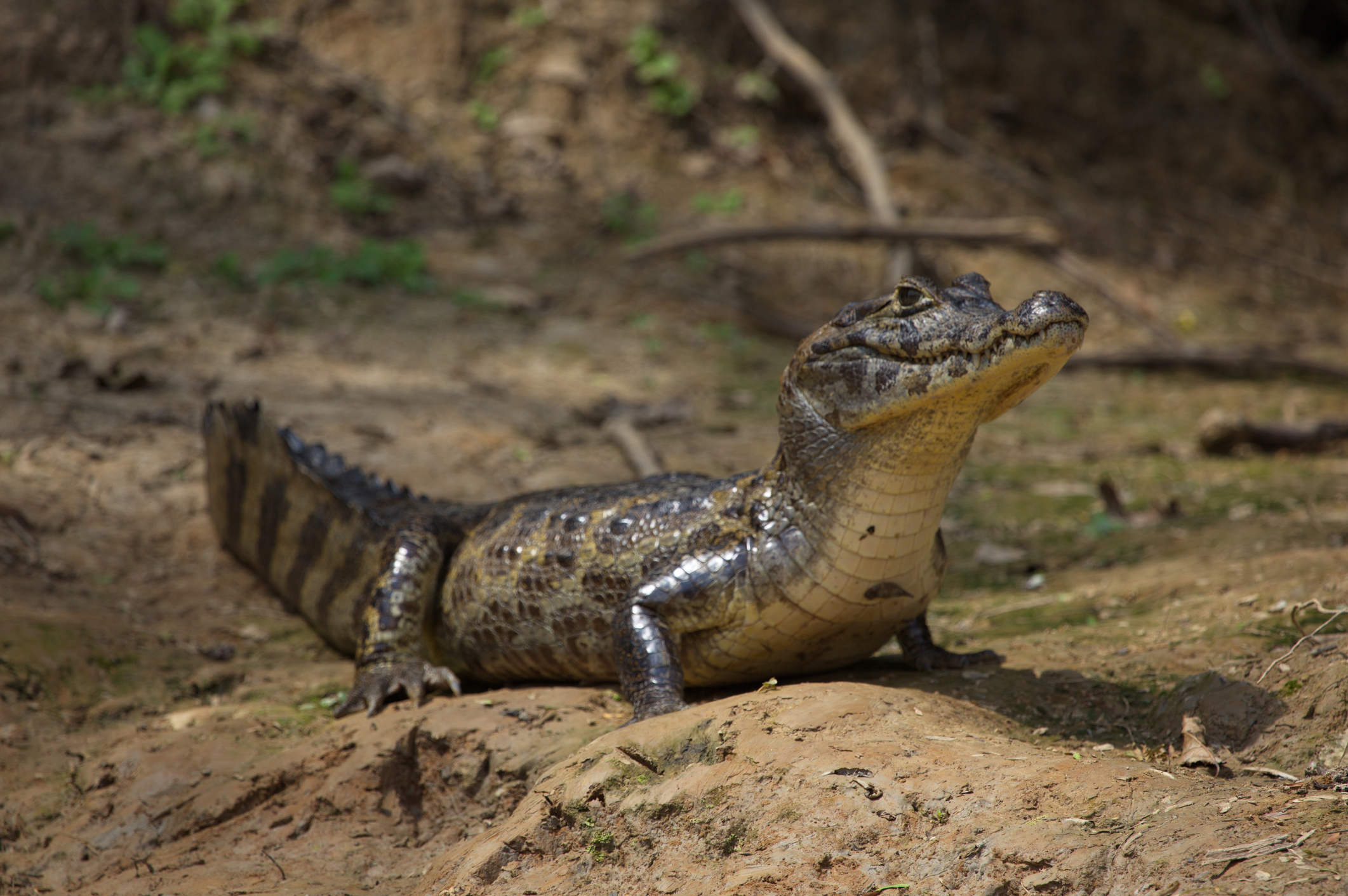
This reptile has a broad, powerful head, muscular tail and heavily armoured body. Its thick, scaly skin is reinforced with bony plates called osteoderms, which provide protection from injury. True to its name, the adult is dark olive-green to almost black, helping it blend into the murky waters of its Amazonian habitat. I
ts large eyes and nostrils are positioned high on its head, allowing it to see and breathe while remaining almost completely submerged. Young black caimans have distinctive pale yellow or white bands across their bodies and tails, which gradually fade as they mature.
They have between 72–76
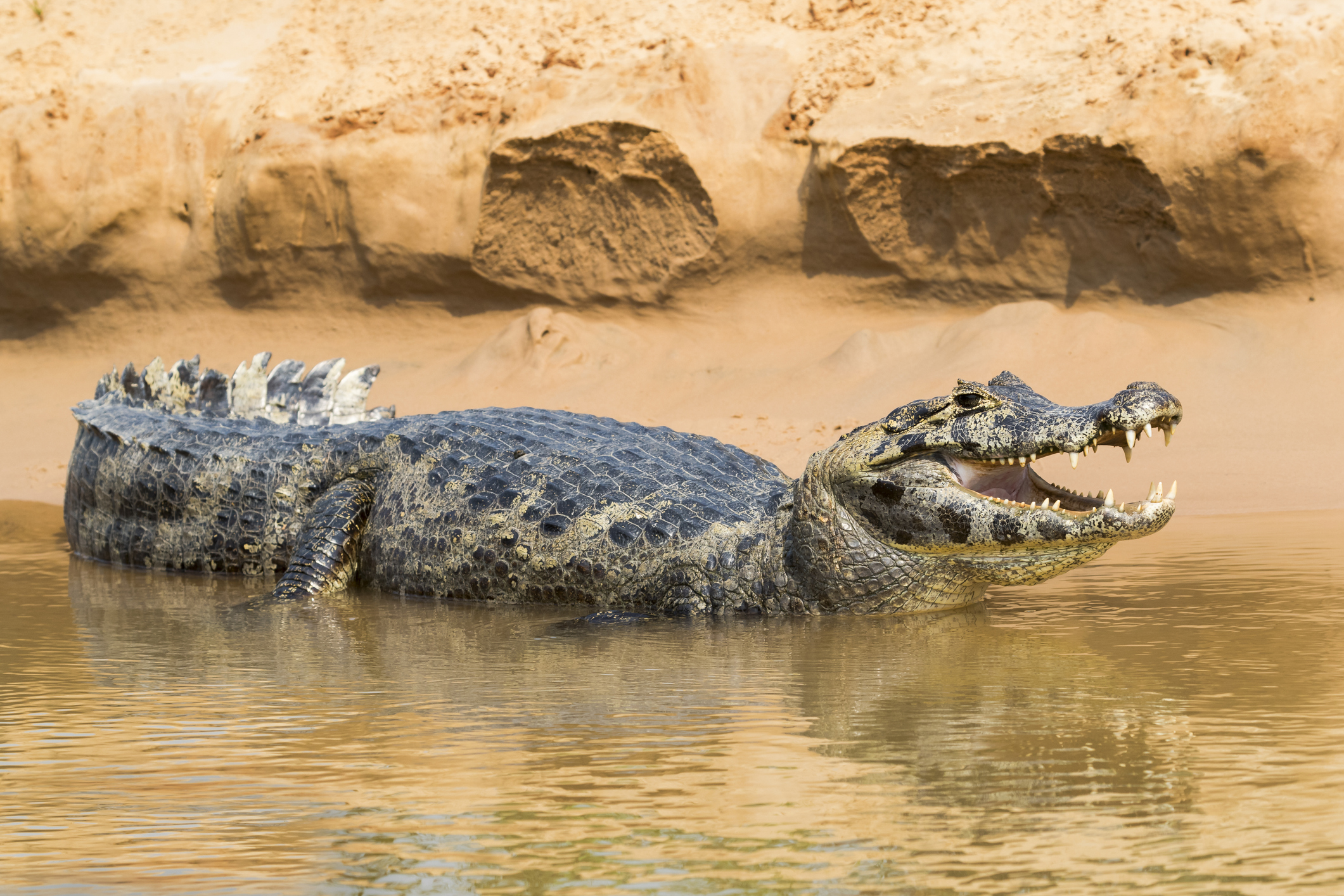
How big are black caimans?
Black caimans are between 4–5metres long and weigh about 350kg
Why do its eyes shine at night?
As in other crocodilians, a reflective layer behind the black caiman’s retina, called the tapetum lucidum, helps it see in dim light by reflecting light back through the eye. This also produces the reddish eyeshine that biologists look for when surveying the species after dark.
What does it eat?
Its diet also responds to seasonal opportunities. At Agami Pond in French Guiana, scientists observed the black caiman feeding on adult herons and chicks that had fallen from nests above the flooded forest.
- Scientists looked inside the heads of crocodiles – and made an astounding discovery
- Crocodile vs alligator: what's the difference between these two fearsome apex predators?
- It has a bite force of 9,452N with jaws built for crushing and holding prey – and can swallow its prey whole
Does it really eat other caimans?
Yes. During the same study, scientists observed that a juvenile caiman entering an adult’s territory could itself become prey. They witnessed two instances of adults attacking juveniles, with cannibalism occurring in some cases. These observations are striking, but do not establish how common cannibalism is elsewhere.
How does it catch its prey?
The black caiman is mainly active at night and remains unseen by submerging most of its body beneath the water’s surface. Like other crocodilians, it has sensitive organs in the skin around its jaws that detect disturbances in the water.
A sweep of its powerful tail propels it towards unsuspecting prey, which it grips with sharp, conical teeth. These are suited to holding struggling animals rather than chewing them.
They have between 72–76 teeth
Does it attack humans?
Yes, and some attacks have been fatal. An analysis of the CrocBITE database recorded 69 black caiman attacks across six countries between 2000 and 2020, including 18 deaths. In the Amazon, attacks are generally on fishermen, when they dive to retrieve nets and the reptiles are subsequently disturbed. Children are also at risk when they bathe in flooded areas. Still, attacks are rare.
How does the black caiman breed?
Towards the end of the local dry season, the female builds a mound of vegetation near water and lays several dozen eggs, sometimes as many as 60. The nest insulates the developing young, which generally hatch after two to three months.
The female often stays close enough to protect her clutch, although her presence does not guarantee its survival. In one Guyanese study, tegu lizards reached more than 30 per cent of monitored nests, usually eating every egg.
- “His wrist was gripped and ‘death-rolled’ three times”: Why conservationists in the Amazon are catching caimans
- It's bigger than London, teeming with a staggering 30,000 dangerous alligators and is one of the deadliest lakes on the planet
- "These are not ordinary teeth as not only are they razor sharp and coated with iron, they have a pair of venom glands in their lower jaws" World's 7 deadliest reptiles
Can a baby black caiman call for help?
Yes. Researchers recorded two kinds of calls from the black caiman’s young: ordinary contact calls and sounds made when distressed. In playback experiments, each call prompted a different response from the mother and the other siblings, suggesting that a hatchling can convey information about danger, allowing family members to respond accordingly.
Why did its numbers collapse?
Demand for its valuable hide caused severe population declines during the 20th century. Legal protection and improved management have since helped the black caiman recover in parts of the Amazon. The IUCN listed it as Least Concern in 2025, although illegal hunting and damage to wetlands remain local threats.
top image: Caiman eyes glowing red in the light. Credit: alexeys/ Getty Images
Discover more fascinating reptile stories from around the world:
- It has iron-coated razor-sharp teeth, weighs the same as a keg of beer and delivers its deadly venom by raking its teeth through its prey’s flesh
- “This was just one of two blue- tongues stuffed inside that DVD player. Another package was detected containing more blue-tongues bound with tape"
- Scientists analysed the DNA of world’s oldest land animal. What they found was staggering


