
Look around you and you’ll see many green animals. There are green insects, green fish, green reptiles, and green birds, but there are no green mammals - why is that?
- Why are tropical wild animals so colourful and diverse?
- Candy-coloured kingfishers, jewel-encrusted hummingbirds and pheasants in regal hues – discover the 11 most colourful birds
In a predominantly green world, being green seems like it would have its perks, especially if you’re trying to avoid the gaze of a hungry predator. The colour green also benefits predators, such as tree snakes and praying mantises, which rely on verdant camouflage to keep them concealed from their prey.
How is the colour green create in the animal kingdom?
While plants produce vast quantities of green pigments, notably chlorophyll, most animals are incapable of creating green pigments - though there are some that produce true green pigments, such as turacos, African birds whose feathers contain a unique pigment called turacoverdin.
Instead of creating green pigments, most green animals rely on a structural colour trick where a layer of yellow pigment (i.e. carotenoids or pteridines) sits on top of microscopic skin or feather structures that scatter blue light (a process known as Tyndall scattering). When yellow filters over blue, our eyes see green.
However, unlike insects, fish, reptiles, and birds that derive structural colour from scales, feathers, and layered skin cells, mammals get their colour mostly from their hair. Compared to these other adaptations, hair is stringy and cannot easily refract light. It’s also incapable of producing green pigments, only shades of black, brown, and orange.
- Why aren't there more green butterflies?
- 8 green woodpecker facts you need to know
- Green lacewing guide: lifecycle, diet, size - and why green lacewings are a gardener's friend
Why are so many mammals brown?
The majority of mammals are a variation on a theme, and that theme is remarkably beige.
There are, of course, exceptions: blue whales, pink river dolphins, white rhinos, and red foxes for example. But in many of these cases, their names are doing a lot of the heavy lifting - in reality, they’re quite drab when compared with other colourful animals.
One mammal that certainly isn’t drab is the mandrill (Mandrillus sphinx). Adult males are widely considered the world’s most colourful mammals, displaying bright red snouts, brilliant blue facial ridges, and a yellow beard. Their backsides are similarly colourful and get brighter depending on an individual’s levels of testosterone and social status.
- It has brilliantly-coloured buttocks, electric blue faces and weighs the same as a Labrador
- How and why do seahorses change colour?
As for how they make their vibrant reds and blues, mandrills rely on two different biological mechanisms: blood flowing through tiny vessels close to the surface of their noses for the red, and parallel, light-reflecting collagen fibers just beneath their skin’s surface for the blue.
Still, mandrills aren’t green.
Why are there no green mammals?
While we can see varying shades of green, most mammals can’t. This is because we have three types of light sensitive cones in our eyes (i.e. trichromatic), whereas most other mammals have just two (i.e. dichromatic).
As a result, it’s harder for dichromatic mammals to distinguish between reds and greens. Instead, they perceive their surrounding environments in muted shades of blue, yellow, and grey. This means that if you’re a mammal trying to disappear into a forest, being green won’t really help.
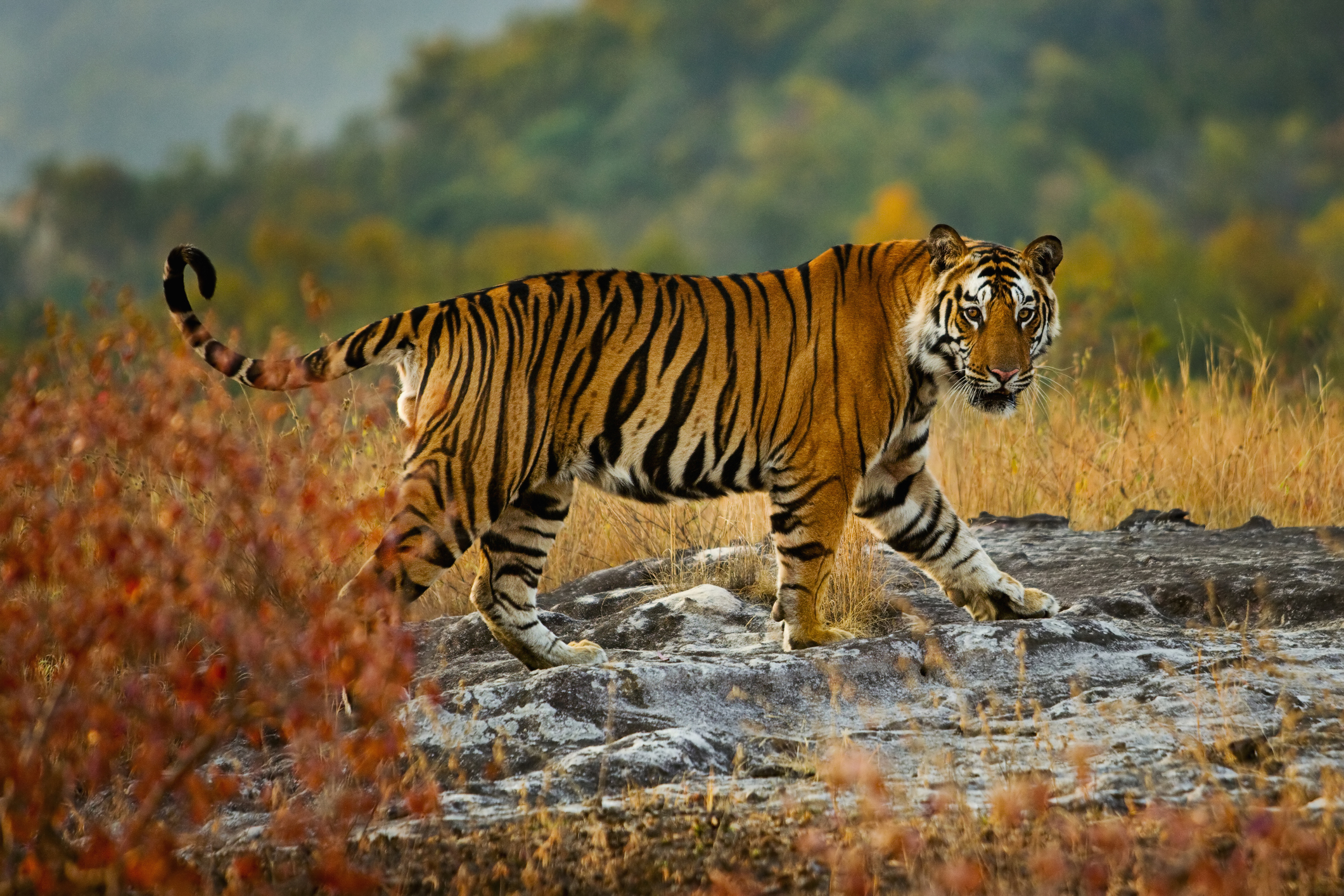
Rather, dichromatic mammals rely on stripes, spots, and other patterns for camouflage, as these help to break up their shape against backgrounds of grass, bushes, and trees. That’s why bright orange tigers are able to sneak up on their prey; their stripes disguise the outline of their body while their orange fur makes them indistinguishable from their green surroundings.
So, why can humans distinguish between reds and greens when most other mammals can’t? To answer this question, we have to go back to the time of the dinosaurs (i.e. the Mesozoic) - a time when mammals were mostly nocturnal.
In low-light conditions, dichromatic vision is actually advantageous over trichromatic vision, as there’s more space in the retina for light-sensitive rods. This means that dichromats can typically see better in the dark.
However, as mammals moved into different niches towards the end of the Mesozoic, some evolved better colour vision, probably as an adaptation to their fruit-based diets. Being able to distinguish ripe red and orange fruits from a sea of green leaves, after all, is a particularly useful skill if fruit is on the menu.
One group of mammals that developed a particular taste for fruit during this time were primates. As our ancestors evolved, their colour vision got better and better.
Today, some humans (almost always females) are born with a rare genetic condition that gives their retinas four types of cone cells, rather than the usual three. This type of vision is known as tetrachromatic vision and it can allow people with the condition to see an estimated 100 million colours compared to the more standard one million.
The verdant outlier
There is one notable exception to the no-green-mammals rule: sloths.
Unlike most mammals, sloth hair lacks a smooth surface. Instead, strands are covered in deep grooves that trap rainwater from the humid rainforests where they live. This trapped moisture, combined with the sloth’s slow-moving lifestyle and high canopy shade, encourages the growth of green algae, turning their furry coats into mini hydroponic gardens.
The relationships between sloths and the green algae living in their fur is actually considered symbiotic. The sloth’s hair provides the green algae (primarily species of Trichophilus) with a stable environment to grow, while the green algae helps the sloth blend into the canopy and avoid the gaze of sharp-eyed predators, such as harpy eagles (which are tetrachromatic and can therefore distinguish green from other colours).
Sloths also host species of moths found nowhere else, whose waste acts as a nitrogen-rich fertiliser for the algae. When sloths climb down to the forest floor to relieve themselves, these hitchhiking moths lay eggs in their faeces. After hatching, larvae feed on the faeces before emerging as adults and flying off to find a new, hairy host. A single sloth can host as many as 120 moths!
top image: Jackson chameleon, Trioceros jacksonii. Credit: Tanto Yensen/ Getty Images
More wildlife stories from around the world:
- Wild animals stranded on island in Kenya. Scientists visited 5 years later – and found something worrying
- It’s larger than New York State and contains more than 30 billion tonnes of carbon – equivalent to 3 years of global fossil fuel emissions
- “Just freakish!” Experts uncover something extraordinary in one of the driest places on Earth


