
If you came across a Chalicotherium in the wild then you’d be forgiven for thinking you’d come face to face with an escaped laboratory experiment - with the head of a horse, the body of a gorilla, and the appetite of a giant panda, it really does look like a Frankenstein’s monster. But this beast wasn’t a work of fiction, it lived across Europe, Asia, and Africa for millions of years.
What was Chalicotherium?
Chalicotherium, whose name means ‘gravel beast’ in Ancient Greek, is an extinct mammal that lived across Europe, Asia, and Africa from the Early Miocene (23 million years ago) to the Late Miocene (5.3 million years ago).
It belongs to an eponymously named family of mammals known as Chalicotheriidae, which can trace its roots all the way back to the Middle Eocene, approximately 46 million years ago. The members of this group are collectively known as chalicotheres and, like Chalicotherium, also look like strange mammal hybrids.
The first chalicothere remains were discovered in the early 19th century at a site near Eppelsheim, Germany, and were originally attributed to giant pangolins. They were later interpreted as the remains of a strange, chin-tusked elephant known as Deinotherium before they were finally assigned to a new family of mammals.
- It looks half-zebra, half-giraffe and has a 50cm tongue that can lick its own ears. Meet one of the world's most confusing animals.
- Adorable footage shows giant panda chomping on bamboo in Chinese mountains
- 5 British dinosaurs you've (probably) never heard of
What did Chalicotherium look like?
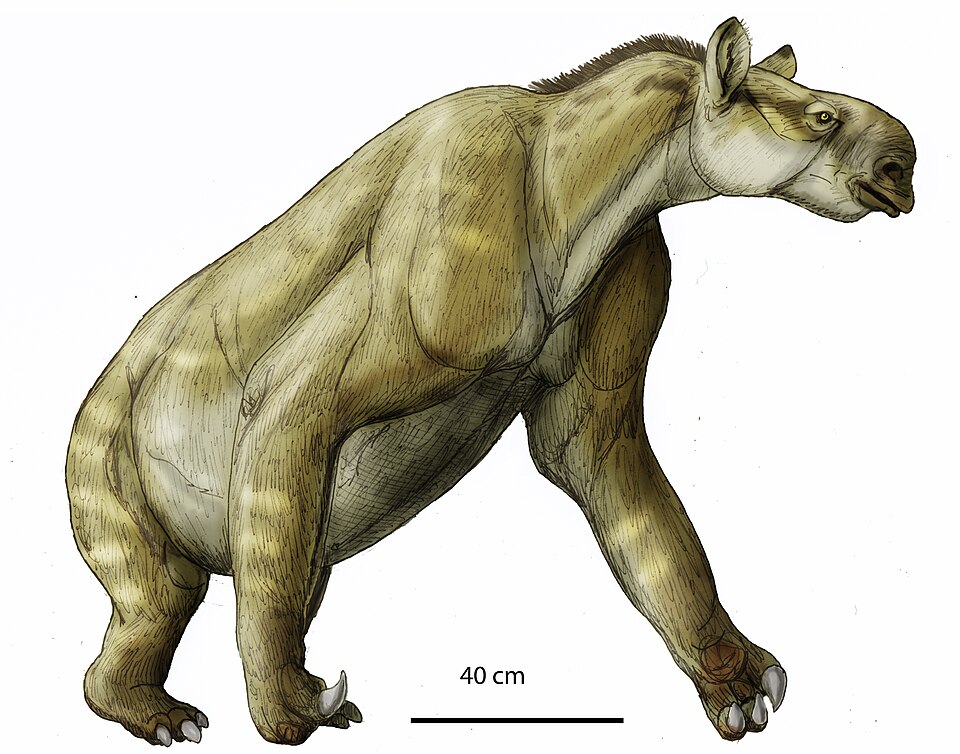
The best way to describe Chalicotherium is as the real-life embodiment of the animal mix-up game, where children combine three different animal parts to create the strangest creatures they can imagine. In fact, splitting Chalicotherium into three distinct parts is the best way to imagine what it looked like.
Up top it had a head like a horse, with a long tongue similar to that of a giraffe. Its arms (or forelimbs) were incredibly long - almost twice the length of its legs - and tipped with claws that could be retracted as it walked on its knuckles, like a gorilla. The back end of Chalicotherium resembled that of a bear, or a giant ground sloth. It had shortened, robust hindlimbs that allowed it to stand upright while it reached for vegetation with its elongated arms.
- This prehistoric apex predator is older than trees, the Atlantic Ocean and even the North Star. A biologist explains why
- 10 terrifying prehistoric mega-beasts that ruled before the dinosaurs – from a car-sized millipede to an armoured fish whose bite could crush steel
Chalicotherium was also a giant. Standing nearly 3m tall and weighing in at 1.5 tons, this strange mammal was comparable in size to modern rhinos.
Given this strange combination of features, it’s understandable why Chalicotherium - and chalicotheres as a whole - are sometimes nicknamed ‘gorilla horses’.
Where did Chalicotherium live?
The chalicotheres can be split into two distinct subfamilies, the chalicotheriines and the schizotherines. The former, which includes Chalicotherium, lived almost exclusively in moist, closed-canopy forests, while the latter lived in a variety of forest, woodland, and savannah habitats.
This difference in habitat is largely down to differences in their anatomy. Chalicotherium and other chalicotheriines were highly adapted to dense forests with lots of trees and tall shrubs that they could strip using their massive, curved claws. Schizotherines like Moropus, on the other hand, had relatively equal limb lengths and looked more like long-necked horses. They were better suited to more open habitats, where they’re thought to have browsed on vegetation from the tops of trees, much like giraffes do today.
Based on the fact that chalicothere fossils are very rare - even in areas where other mammals of similar sizes are well-preserved and in abundance - palaeontologists think they were mostly solitary animals. Unlike their distant cousins horses, rhinos, and brontotheres, chalicotheres likely never evolved into species that congregated in herds.
As a group, chalicotheres have been found on several different continents, from North America to Europe, Asia, and Africa. Chalicotherium is largely known from the fossils found in Germany in the early 19th century, though some remains have since been discovered in India and China.
- These prehistoric terror birds – with 'walking bolt cutters' for beaks – would have petrified early humans
- Deadly prehistoric snakes the length of a bus, 7 tonne crocodiles and supersized penguins almost 2 metres high - 11 animals that used to be bigger
What did Chalicotherium eat?
While its anatomy was certainly strange, Chalicotherium was clearly adapted to browsing - a type of herbivory whereby a herbivore feeds on leaves, soft shoots, or fruits of high-growing, generally woody plants. This is different from grazers, which is a term applied to herbivores that feed almost entirely on low-growing plants, such as grasses.
It’s believed Chalicotherium used its long, clawed arms to reach for the branches of trees and bring them close to its mouth, which it would then use to strip the branches clean of leaves. Calluses on its sit bones also suggest it would sit on its haunches for extended periods of time, presumably while feeding.
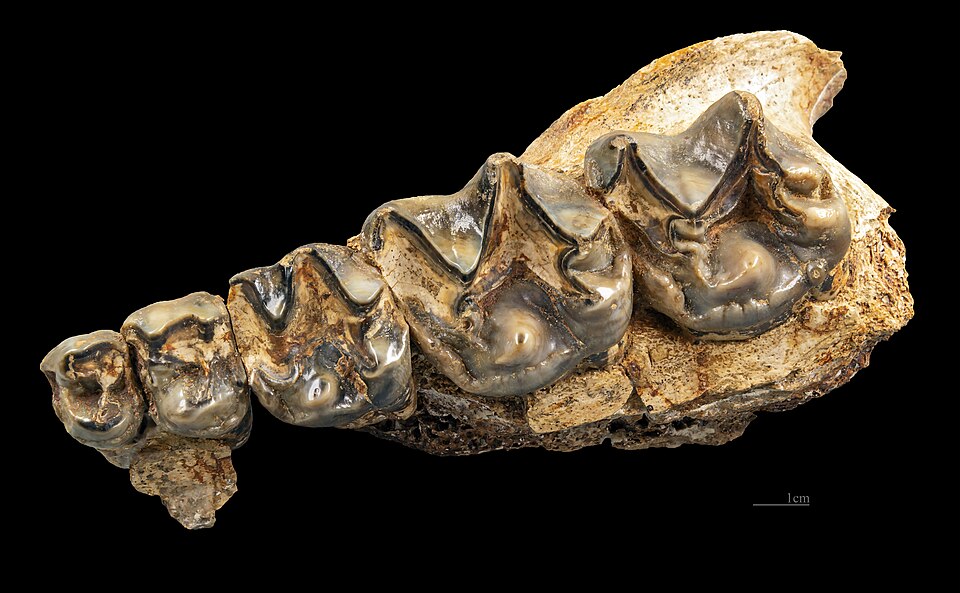
Studies of its teeth confirm interpretations of its feeding habits. Based on wear patterns, it’s clear Chalicotherium had a particular taste for bark, twigs, and leaves. It also had very muscular cheeks, which suggests it was well adapted for chewing mouthfuls of plants.
- It was a 2-metre-tall, 500kg prehistoric monster pig with bone-crushing jaws – one of the most ferocious predators ever to have lived
- "Its vicious-looking, self-sharpening teeth were designed to slice effortlessly through tough meat." 10 deadliest, most ruthless prehistoric cats ever
This kind of diet, and the adaptations necessary to support it, is reminiscent of other browsing mammals, such as giant ground sloths, great apes, and bears, as well as a bizarre group of plant-eating theropod dinosaurs known as therizinosaurs.
How does Chalicotherium fit in the mammal family tree?
The chalicotheres belong to an order of mammals called Perissodactyla, or as they’re more commonly known: the ‘odd-toed ungulates’. These mammals are distant cousins of artiodactyls, or the ‘even-toed ungulates’, which includes everything from cows, sheep, and pigs, to giraffes, hippos, and even whales.
Perissodactyla includes just 17 living species, which is a mere fraction of the 350 that make up Artiodactyla. These 17 species are split between three distinct families: horses, rhinos, and tapirs. Together, these three groups are distant cousins of chalicotheres and their closest living relatives.
During the Eocene, Oligocene, and Miocene, the perissodactyls were considerably more diverse. Alongside horses, rhinos, and tapirs, there were chalicotheres, brontotheres, palaeotheres, and paraceratheres.
The latter of these families includes the largest terrestrial mammal that’s ever lived, Paraceratherium. At 4m tall, 7.5m long, and 20 tons, this prehistoric powerhouse was more comparable in size to the largest dinosaurs, sauropods, than the largest mammals alive today.
- The 300-million-year-old prehistoric plant that can ‘walk’ and jump – and you may have it growing in your garden
- "It has two, whopping, 22cm-long fangs that give it the look of an aquatic saber tooth tiger."10 deadly, utterly terrifying prehistoric fish
Why did Chalicotherium become extinct?
Chalicotherium faced extinction 5.3 million years ago, just as the Miocene ended and the subsequent period, the Pliocene, began.
As fossils of Chalicotherium are very rare, it’s unclear exactly why it became extinct, but palaeontologists think it may have had something to do with the long-term global cooling and drying trend during the Late Miocene. This climatic shift caused dense forests to shrink, replacing its habitat with more open grasslands and savannahs.
As a group, however, chalicotheres survived a little longer, persisting deep into the Quaternary and only going extinct in the Early Pleistocene, roughly one million years ago.
- How many species of dinosaurs were there on the planet?
- How on earth did herbivore dinosaurs get enough food?
- Could we have farmed dinosaurs? Meet the tastiest dinosaurs that could have ended up on our plates – had we lived alongside them…
The youngest chalicotheres are Hesperotherium from China, Nestoritherium from Myanmar, and Ancylotherium from Eastern and Southern Africa. These three chalicotheres lived at a similar time - and in similar places - to some of our early ancestors and may have occasionally come across them, or rather found themselves at the pointy end of some sharp sticks.
That said, there’s currently no evidence of humans hunting chalicotheres. It’s most likely the family faced extinction as a result of continued cooling and drying trends, culminating with the onset of the Quaternary glaciation - the ongoing series of alternating ice ages and interglacials that began approximately 2.58 million years ago.
Chalicotherium and other chalicotheres are stark reminders that mammals are no strangers to weirdness. We often look to deep-sea invertebrates, fish, or reptiles for nature’s strangest creations, but Mammalia has produced its own menagerie of evolutionary oddballs. And few are quite as bizarre as a chalicothere.
top image: illustration of Chalicotherium. Credit: ChalicotheriumDB1.jpg: DiBgdderivative work: Artuller, CC BY-SA 3.0 https://creativecommons.org/licenses/by-sa/3.0, via Wikimedia Commons
Discover more wildlife stories from around the world:


