
Researchers have uncovered a previously-unknown mammal-like animal that lived over 160 million years ago. It had a bizarre combination of traits that shed new light on the evolution of one of the defining behaviours of mammals – suckling, swallowing and breastfeeding, which until now has remained a mystery.
- It was a 2-metre-tall, 500kg prehistoric monster pig with bone-crushing jaws – one of the most ferocious predators ever to have lived
- Deadly prehistoric snakes the length of a bus, 7 tonne crocodiles and supersized penguins almost 2 metres high - 11 animals that used to be bigger
The research was led by scientists from the University of Chicago and Ohio University in the US, Shenyang Normal University and Shandong University of Science and Technology in China, and the University of Bonn in Germany. The paper which details its fossilised remains is published in the journal Nature.
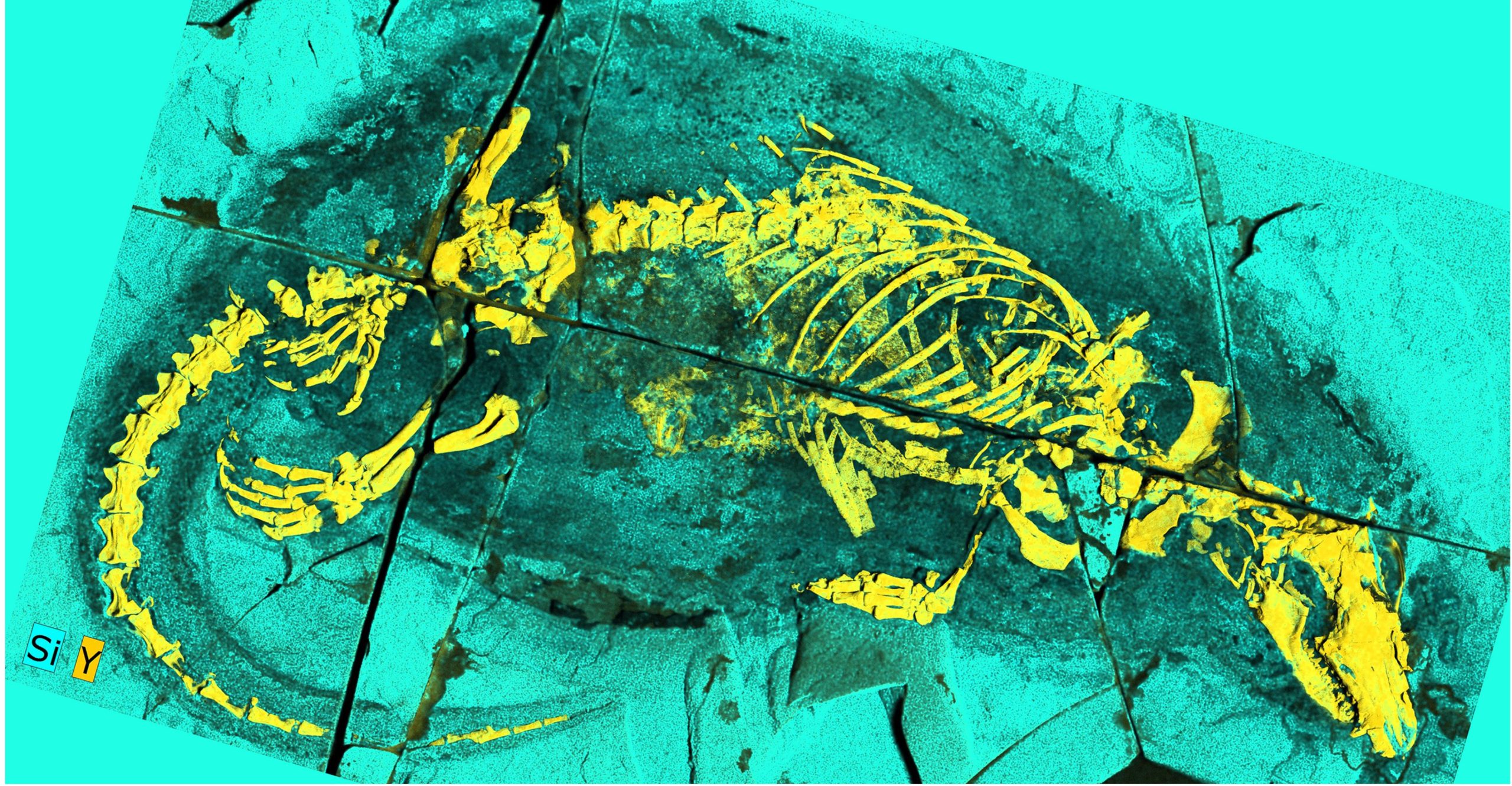
The remains of Megacauda sungei, a large mammal-like animal that lived during the Middle Jurassic Period in what is now Inner Mongolia, China, included an exceptionally well-preserved throat – a very uncommon paleontological find, as soft tissue rarely fossilises well.
At around 1-2kg and about the size of a modern platypus, Megacauda sungei is the largest known Jurassic mammaliaform (a group of animals that contains mammals and their closest extinct relatives). Using high-resolution micro-CT imaging, the scientists reconstructed the skull and skeletal anatomy of the fossil.
The ancient animal has a mix of different traits: specialised blade-like cheek teeth resembling those of modern seals, a platypus-like pelvis, and an otter-like tail. Megacauda sungei was most likely a semi-aquatic predator that hunted small vertebrates and invertebrates in freshwater, paddling with its front legs, moving its tail in a wave-like motion, and steering with its hind legs.
Megacauda sungei also has two other features that make it remarkably similar to modern therian mammals. Therian mammals are those that give birth to live young instead of laying eggs, a group that includes marsupials (such as kangaroos and opossums) and placental mammals such as elephants or humans.
The researchers discovered a pair of small bony projections on the roof of the mouth of the animal, as well as highly specialised hyoid bones in the throat region. In modern mammals, the first feature helps support the soft palate and muscles involved in suckling, swallowing and protecting the airway, while the hyoid bones help anchor muscles for swallowing – both key adaptations and an immense survival advantage.
“It was this adaptation that made brain development, eventually leading to humans, possible,” says Thomas Martin, a professor at the University of Bonn and co-author of the study. “The soft palate and the shaping of the oral cavity and pharynx are directly linked to the evolution of mammals.”
Many species of animal living today don’t have this soft palate and instead have to fair with just a simple hyoid bone apparatus with no swallowing mechanism. For example, crocodiles raise their head up and use movement to slide prey down their throat with the aid of gravity. Mammals can swallow even against gravity – like humans drinking upside down through a straw while breathing.
“The anatomy of Megacauda suggests that structures involved in coordinating swallowing and sucking had already begun to evolve by the Middle Jurassic. This discovery helps us better understand the biological foundations of one of the defining characteristics of mammals: feeding young with milk,” explains Zhe-Xi Luo, a professor at the University of Chicago and senior author of the study.
- Prehistoric soft tissue from a 183-million-year-old dinosaur reveals what it really looked like - shocking scientists
- Stomach, liver and intestines of 245 million year old marine reptile unearthed in Chinese mountains
Challenging assumptions
As soft tissues are rarely preserved in fossils, scientists have long struggled to determine when exactly mammals evolved these important feeding structures. The long-standing assumption was that they evolved directly from primitive bony ridges known from earlier mammaliaforms and mammalian ancestors.
But Megacauda sungei has both the bony projections resembling modern therian mammals and the primitive ridges, suggesting the evolution wasn’t as straightforward as previously thought.
“This fossil captures an important stage in mammalian evolution. For decades, scientists have wanted to know when the soft tissue structures necessary for suckling and complex swallowing first appeared,” adds Luo.
“Megacauda provides some of the clearest evidence yet that many of these innovations emerged well before the rise of modern mammals.”
- Imagine if dinosaurs hadn't gone extinct. Here's what scientists think may have happened next
- New crocodile species discovered in rocks used to build Egypt’s Great Sphinx
This research can also help scientists understand living mammals, such as platypuses or echidnas – the only extant mammals which lay eggs rather than bear live young. These animals use a different method for obtaining milk than therians and lack some of their anatomical features. The new evidence suggests that they likely lost elements of the ancient suckling apparatus at some point during evolution – and developed an alternative method of milk intake.
Beyond biology, the discovery of Megacauda sungei highlights the ecological diversity of mammaliaforms living during the age of dinosaurs.
“These discoveries continue to reveal that the Age of Dinosaurs was also a time of extraordinary evolutionary innovation among early mammals,” says Peishu Li, assistant professor at Ohio University and co-author of the study.
Read the full findings here.
Top image: Megacauda is exceptional for mammals in the Age of Dinosaurs, with a broad tail for swimming, and shearing teeth for fish-eating. It lived a semiaquatic lifestyle, sheltering on shores and foraging in lakes of what is now eastern China. Credit: April I. Neander


