
The history of life on Earth doesn’t start with the Cambrian Explosion. However, this was the point in time that nearly all major animal groups appeared, proliferated, and diversified.
For centuries, scientists have debated what sparked this sudden boom in diversity, arriving at no clear conclusions. Now, a team of scientists from Australia and Germany have proposed an eruption of excrement may have been the catalyst.
What was the Cambrian Explosion?
The Cambrian Explosion is an interval of time marked by a sudden increase in the diversity of complex life.
Starting approximately 538.8 million years and lasting for 13 to 25 million years, this is the point in the history of life on Earth when nearly all major animal phyla emerged, from molluscs, arthropods, and echinoderms, to chordates - animals with stiff, supporting spines known as notochords.
This radiation of life took place at the start of the Cambrian and saw animals experiment with a wide range of different body plans. It’s these body plans that help scientists place animals (both living and extinct) into distinct phyla.
- 500-million-year-old clawed predator found in Utah desert forces scientists to rethink origin of spiders
- "It has five limbs covered in hundreds of hydraulic, rubbery feet and no head – or even a defined front, back, left or right" – what on Earth are echinoderms?
A phylum is a level of biological classification just below kingdom (e.g. animals, plants, fungi) and just above class (e.g. mammals, reptiles, amphibians). There are about 32 phyla of animals, depending on which definition you use, and the majority of these appeared during the Cambrian.
That said, in recent years scientists have discovered elaborate body fossils in Precambrian-aged rocks, suggesting some phyla may have actually appeared before the famous Cambrian Explosion.
What was life like before the Cambrian explosion?
While the Cambrian Explosion may be the point in time that animals truly exploded onto the scene, this kingdom of life can trace its roots back much further. In fact, the first animals may have appeared as far back as 800 million years ago - just before a period known as ‘Snowball Earth’, when our planet was almost entirely covered by ice.
These early animals were very simple, resembling sponges and/or comb jellies (known as ctenophores). There’s a big debate surrounding the identity of the first animals, with some arguing sponges arrived first on the scene and others claiming comb jellies beat them to it by a few million years.
Regardless of which group emerged first, animal life before the Cambrian looked very different to how it did during and after this evolutionarily important period. The animals that lived at this time were soft-bodied and largely immobile, rooting themselves to the seafloor and extracting food from the water column using their bizarrely shaped bodies.
- Prehistoric prey and predator fossil discovery reveals a violent fight for survival millions of years ago, in first-ever evolutionary arms race
- “One of the longest-running cold cases of palaeontology.” Scientists may finally know what created these strange markings
Some of these early animals were able to move, though not quite in a way that any animal does today. Dickinsonia is an example of one of these early, mobile animals. It resembled a large, flattened leaf, but it was an animal and by using rhythmic muscular contractions it was able to move slowly over the seafloor.
As Dickinsonia and other early, mobile animals moved across the seafloor, they’d secrete digestive enzymes, breaking down microbial mats and allowing them to absorb nutrients. Other animals, such as Kimberella, used radula-like structures to physically scrape bits of algae off the seafloor. A functional gut then helped them digest this food.
Dickinsonia, Kimberella, and other well-known Precambrian animals such as Charnia and Spriggina lived during a period known as the Ediacaran, which lasted from 635 million to 541 million years ago.
These animals are referred to as Ediacaran Biota and while they were once viewed as failed, evolutionary dead ends, they’re now considered a foundational chapter in early animal evolution.
- Biggest scorpion to ever live revealed from 415-million-year-old fossils. It was 1m long and had pincers larger than table knives
- It ruptured the eardrums of sailors, was heard thousands of miles away and the pressure wave circled the Earth
What was life like during the Cambrian?
As the Ediaracan became the Cambrian, the seafloor - and its associated biological communities - got a whole lot more complex. What was once a drab marine desert relatively devoid of life quickly transformed into a rich marine ecosystem full of active, complex animals.
This transition saw animals develop defined heads, tails, and complex muscles for burrowing, swimming, and hunting.
The arrival of active hunters also sparked an arms race between predators and prey, necessitating hard parts such as shells and skeletons. This sudden appearance of hard, mineralised parts is why the fossil record dramatically improves following the Cambrian!
- What was the first-ever deadly apex predator? Clue – it lived 500 million years ago…
- “Jeez, talk about a Dr Seuss-like landscape." Underwater robot discovered bizarre ‘forest’ full of animals all facing in the same direction. Here’s why...
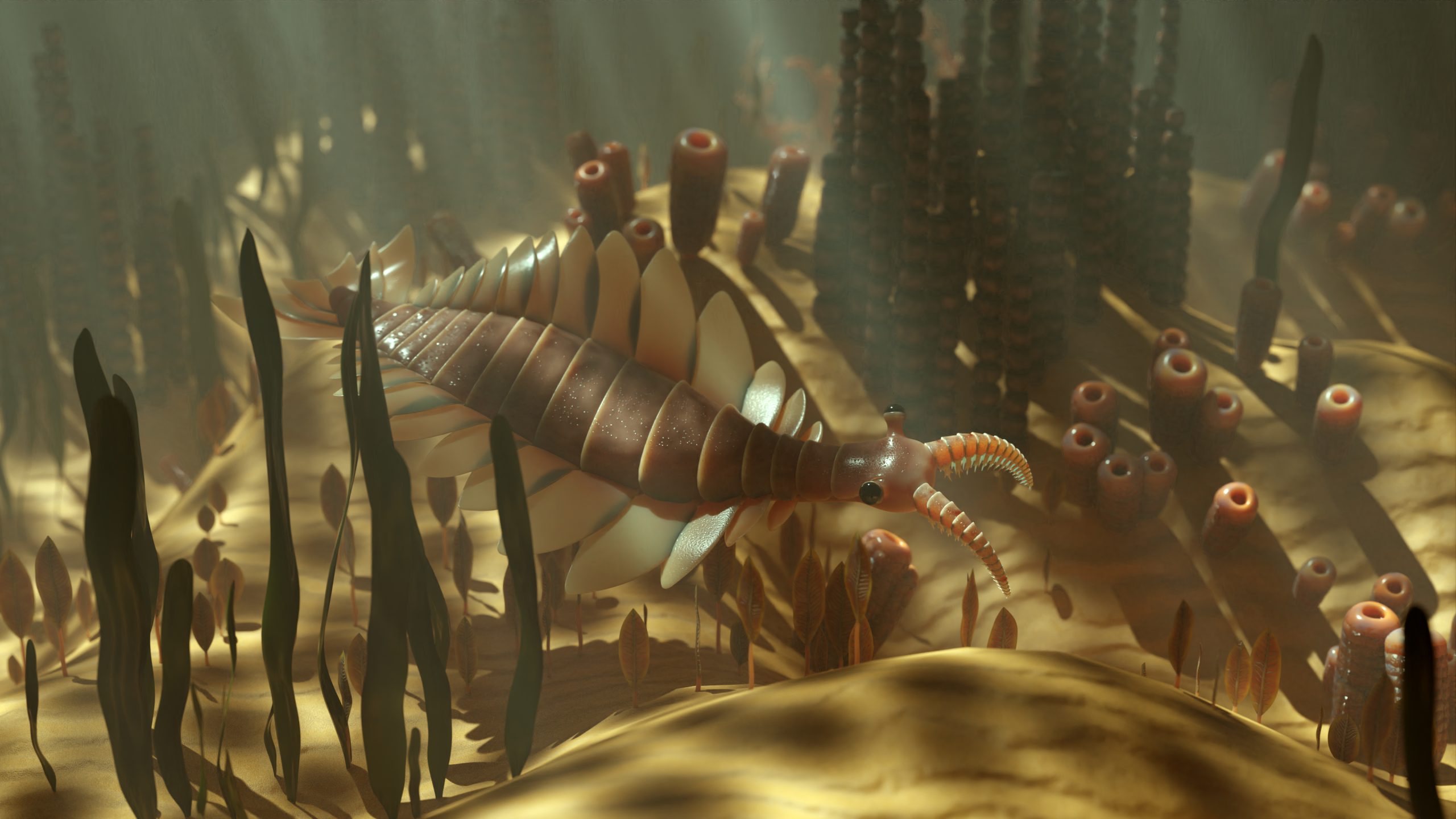
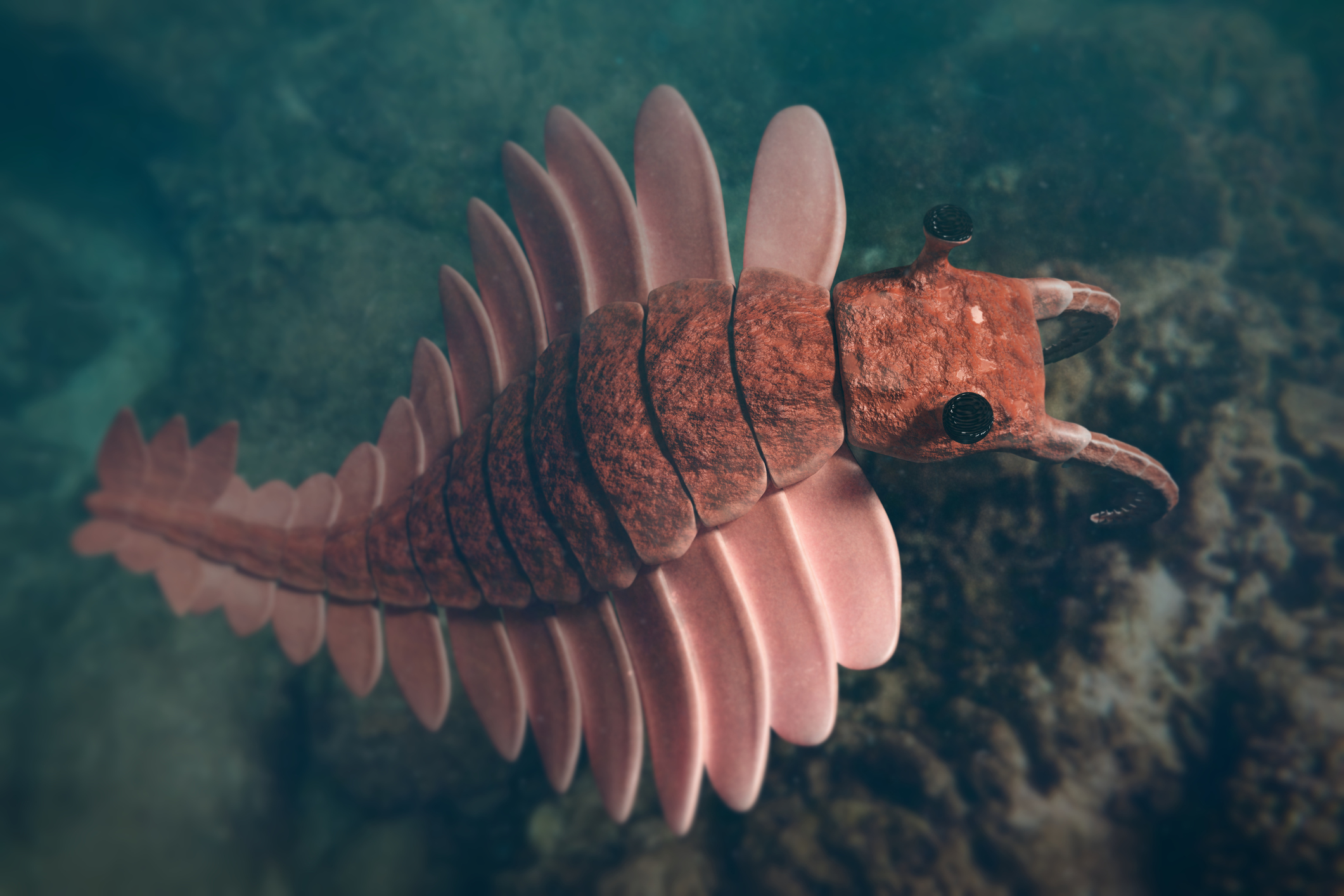
There are several recognisable animals that lived during the Cambrian, including hard-shelled, woodlouse-like animals known as trilobites and voracious, predatory shrimp known as radiodonts. The radiodont Anomalocaris was one of the deadliest predators during this period and used a pair of large, spiny front appendages to catch its prey.
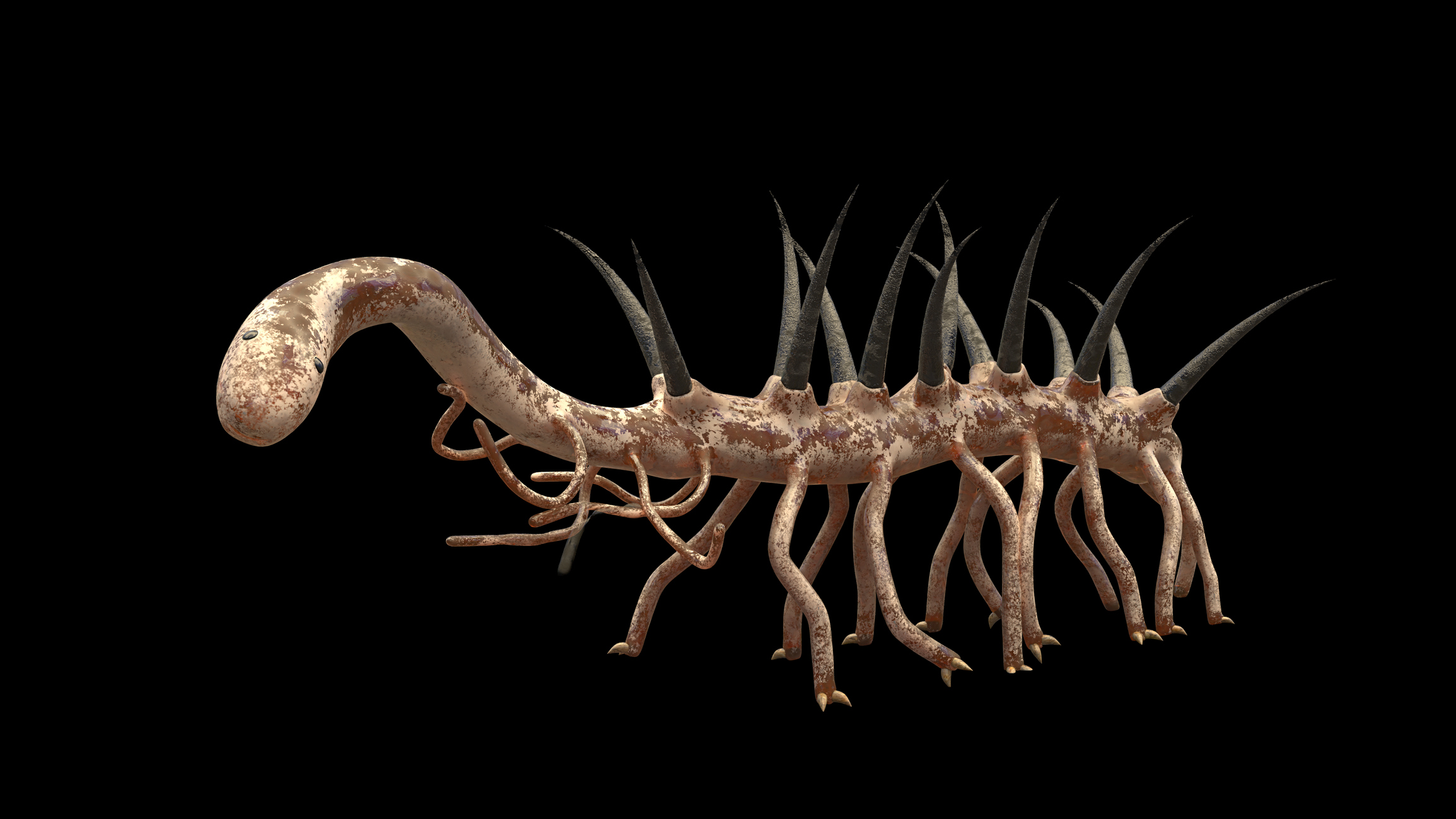
Other, lesser-known animals from the Cambrian include Hallucigenia, a spiny, worm-like creature that looks more alien than animal, Opabinia, a soft-bodied arthropod with five eyes and a trunk, and Wiwaxia, a hedgehog lookalike that still confuses scientists as to where it falls on the tree of life.
The Cambrian was also the period during which our earliest, backbone-bearing ancestors evolved. The oldest chordate currently known to science is the eel-like animal known as Pikaia. This was the first step on the long, evolutionary journey towards us - humans.
There may be little resemblance between Pikaia and you, but inside Pikaia is the key feature that separates you and roughly 95% of other animals (i.e. the non-chordates) - a notochord.
From Pikaia emerged fish, and when their limbed descendants crawled out of the water around 375 million years ago, they opened the door to an entirely new world - one that was soon taken over by amphibians, reptiles, mammals, birds, and - eventually - humans.
What do scientists think caused the Cambrian Explosion?
There have been many suggestions as to what may have sparked the Cambrian Explosion, ranging from an increase in oxygen levels and mineral content in seawater, to the work of ecosystem engineers, such as worms and other burrowing organisms.
For the first two billion years of its 4.5-billion-year-long history, Earth had no significant free oxygen - the oxygen that animals breathe today, both in the air and dissolved in water, is the byproduct of billions of years of photosynthesis.
At first, oxygen produced by photosynthesis was bound to minerals such as iron. However, once these minerals were bound and used up, oxygen began to exist as free molecules in the atmosphere. From there it dissolved into the oceans, boosting oxygen levels past a threshold that could sustain complex life.
- It drills through shells with a cocktail of acid and enzymes – then liquefies its victim inside their own home
- Scientists have made a freaky 3D printed gel that’s alive – and eats CO2 (twice over)
An increase in dissolved mineral content may have also passed a certain threshold during the Cambrian. The release of mineral-forming elements such as calcium and phosphorus from volcanic vents on the seafloor and from the erosion of rocks on land during this time gave many early animals the materials they needed to start building hard parts.
As well as changes in the environment, scientists also point to animals themselves as being potential catalysts of the Cambrian Explosion. While animals may largely be shaped by the environments they live in, they can also change and shape their surrounding environments.
For example, animals started burrowing around the Cambrian. This disturbed the seafloor, aerating it and releasing minerals and nutrients that were previously inaccessible. It’s thought burrowing may have made seafloors during the Cambrian more hospitable, creating new niches that animals could evolve into.
Another factor that scientists think may have sparked, or at least fueled the Cambrian Explosion, is the aforementioned predator-prey arms race. As animals became more active and moved into more predatory niches, their prey responded in kind by evolving spines, armour, and other defences to avoid being eaten.
Some scientists have even suggested this period of prehistory may have been more of a damp squib than an evolutionary explosion. These scientists suggest the Cambrian Explosion may just represent a genetic complexity threshold being crossed - organisms that use more oxygen have the opportunity to produce more complex proteins, which, in turn, facilitates the evolution of a wider range of body plans.
- Did sex stop Earth from being boring? Probably, say scientists
- Would any animals survive a nuclear explosion?
Did an increase in fecal matter really spark the Cambrian Explosion?
In July, 2026, palaeontologists Julien Kimmig and Russell Bicknell proposed a new catalyst for the Cambrian Explosion: a so-called ‘fecal revolution’.
This preliminary study analysed the coprolite (i.e. fossil poo) record, the evolution of animals’ digestive tracts, and its potential effects on the ocean’s biological pump - the natural process that cycles nutrients from the ocean’s surface to the seafloor.
- "It lives in poop and detonates its spores at 90kph..." 7 fascinating – and weird - facts about animal poop. You won't believe number two...
- Fossil poo, fossil vomit, fossil penis... World's 10 weirdest fossils that will have you scratching your head
Kimmig and Bicknell found that, “the rapid acceleration of organism size during the Cambrian Radiation increased coprolite size, which yielded a positive feedback loop, further accelerating the establishment of these [complex] ecosystems.”
In other words, as larger, more varied butts appeared and did their thing, spreading poo across all levels of the ocean, important nutrients were made available for burgeoning groups of animals. According to this new theory, ‘poo power’ quite literally fueled the evolution of complex animal life.
There are still many outstanding questions that Kimmig and Bicknell plan to answer with further research, chiefly what elements and nutrients this poo was composed of and how they may have been utilised by early animals.
To answer these questions, they’ll have to wade through a lot of poo - both figuratively and literally.
Top image: Cambrian explosion or Cambrian radiation. Credit: canbedone/ Getty Images
More wildlife stories from around the world:


